
You're earning well. Your business is growing, your career is progressing.
You have valuable assets—investments, policies, trusts, retirement accounts—but they were built at different times, by different professionals, without a unified design.
You have a CPA who files your taxes. An advisor who manages your investments. An attorney who drafted a trust years ago. An insurance agent handling policies.
Decisions get made in isolation. Investment choices don’t account for tax positioning. Estate documents don’t reflect current asset titling. Insurance coverage hasn’t been reviewed in light of income growth.
Without a central integrator, coordination becomes reactive instead of strategic.
The result is inefficiency, lost dollars, missed opportunities, stagnant wealth, and a lingering sense that something might be out of sync.
That’s why we created the Macro Planning Method™.
Ultra-wealthy families operate through what’s known as a family office. This is a centralized team that coordinates tax strategy, investment management, estate planning, insurance, liquidity, and long-term legacy design under one integrated approach.
The CPA doesn’t operate separately from the attorney. The investment strategy doesn’t ignore estate structure. The insurance plan doesn’t sit on the sidelines.
Everything works together.
That level of coordination is typically reserved for families with extraordinary net worth.
The Macro Planning Method™ brings that same integrated thinking to families and professionals who want clarity, not complexity.
Find the gaps in your financial plan costing you wealth right now.
The Macro Planning Method™ changes how your financial life is managed.
Instead of focusing on isolated decisions, we step back and evaluate how everything works together.
Macro Planning is not about replacing your team. It’s about integrating it.
Because most financial problems aren’t caused by bad financial decisions in the moment. They are caused by good decisions that were never coordinated.
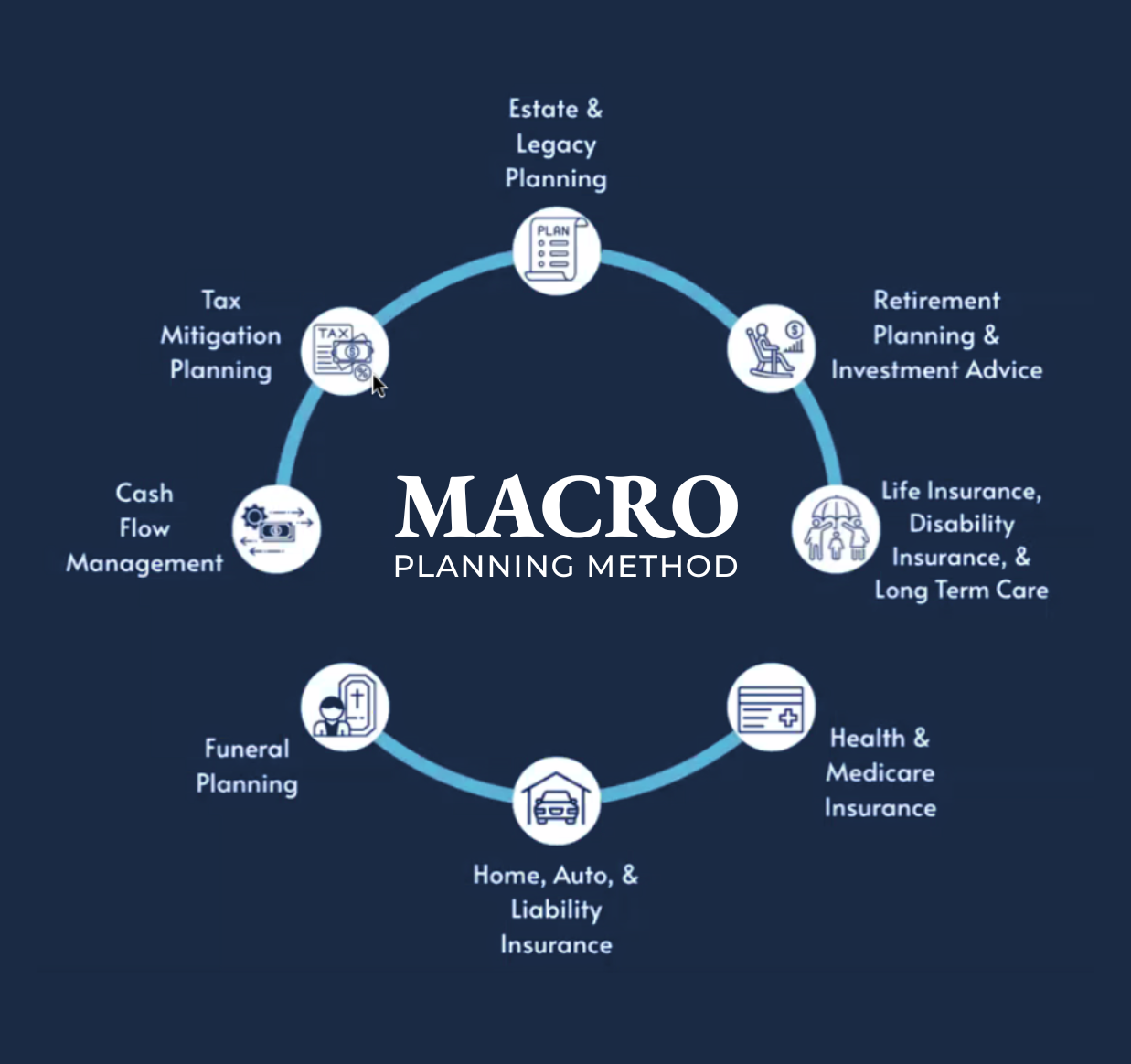
Under the Macro Planning Method™, we examine your financial life as a connected system. That includes:
Estate and ownership structure
Retirement income planning
Investment strategy
Life, disability, and long-term care protection
Cash flow management and optimization
Tax positioning
Liability and risk management
Business and legacy integration
Individually, each of these areas matters. But when they’re managed separately, opportunities are missed and risks go unnoticed.
The Macro Planning Method™ brings oversight to the full picture. Decisions in one area are made with awareness of how they affect the others.
Tax implications are considered before investment moves. Ownership structure aligns with estate design. Liquidity planning reflects real-world needs. Protection is calibrated to actual exposure and needs.
When every moving part operates from the same strategy, your financial life stops feeling like a collection of accounts—and starts functioning like a system.
Step 1: Diagnose the System
We conduct a comprehensive review of your tax positioning, estate structure, insurance design, investment allocation, liquidity profile, and risk exposure as one connected framework.
Step 2: Surface Inefficiencies
We identify overlap, exposure gaps, missed tax elections, idle capital, outdated structures, and uncoordinated advisor decisions.
Step 3: Align and Calibrate
We coordinate with your existing advisors (or introduce aligned professionals if needed) and recalibrate your structure so each decision supports the others.
When your financial life operates as one system instead of separate parts, the difference is measurable and tangible.
You’re no longer the go-between for your CPA, advisor, and attorney. Decisions aren’t made in isolation and then explained later.
Instead, major moves are evaluated in context—before they create unintended consequences.
Investment decisions consider tax exposure.
Tax strategies reflect long-term estate structure.
Liquidity is planned intentionally, not reactively.
Insurance coverage evolves alongside income and risk.
Business decisions are integrated into personal planning.
You stop wondering whether something is being missed. You stop second-guessing whether your plan is “set up right.” You stop discovering inefficiencies after the fact.
Instead, you gain clarity and confidence.
Your financial life isn’t dependent on one advisor’s narrow lens. Each decision is made with awareness of the full picture. Growth doesn’t create new vulnerabilities.
The Macro Planning Method™ doesn’t necessarily add more moving parts. It ensures the ones you already have are working together efficiently.
This coordination leads to simpler and more confident decision making.
Macro Planning is designed for people who are already doing well financially and want structural precision.
Business owners navigating growth, risk, and eventual transition.
High-income professionals managing multiple advisors and complex decisions.
Families building significant assets who want clarity around how everything connects.
Individuals approaching retirement who want integration, not isolated projections.
This isn’t for someone looking for a quick product or a single transaction.
It’s for those who take responsibility for their financial life and want oversight, coordination, and confidence that what they’ve built is working together the way it should.
If you care about getting it right—not just getting by—this is where we begin.
Ready to explore how we may be able to help you identify and fix the potential inefficiencies in your plan?
The first step is a focused, 15-minute Alignment Review. It’s simply a chance to have a conversation, share what prompted you to explore Macro Planning, and see whether we’re the right fit to help.
No pressure. No commitments. No product discussion.
Just a strategic conversation to determine whether moving forward makes sense.
A no-pressure, no-obligation introductory call to see if we’re aligned.
*Disclaimer: Financial Advisors do not provide specific tax/legal advice and this information should not be considered as such. You should always consult your tax/legal advisor regarding your own specific tax/legal situation. Separate from the financial plan and our role as a financial planner, we may recommend the purchase of specific investment or insurance products or account. These product recommendations are not part of the financial plan and you are under no obligation to follow them. Life insurance products contain fees, such as mortality and expense charges (which may increase over time), and may contain restrictions, such as surrender periods.